Vibecoding: How to Build Apps by Just Describing the Vibe

Vibecoding: How to Build Apps by Just Describing the Vibe
You don’t need to know Python to build an app anymore. You just need to know how it should feel.
Welcome to the Era of "Vibecoding"
In early 2025, Andrej Karpathy (one of the founding members of OpenAI) coined a term that perfectly captures where software development is heading: Vibecoding.
For decades, coding was about precision. One missing semicolon could crash a billion-dollar system. You had to learn the rigid grammar of machines—if, else, while, return—and translate your human ideas into their alien logic.
Vibecoding is the opposite. It’s about intent.
Instead of writing:
div { background-color: #f0f0f0; border-radius: 8px; padding: 16px; }
You write:
"Make this card feel softer. Like a Sunday morning. Maybe a bit more breathing room?"
The AI understands the "vibe" (soft, spacious, calm) and translates it into the rigid code the computer needs. It splits the workload: You handle the vision. The AI handles the syntax.
And the best tool for this right now is a platform called Lovable.
Meet Lovable: The Vibecoding Engine
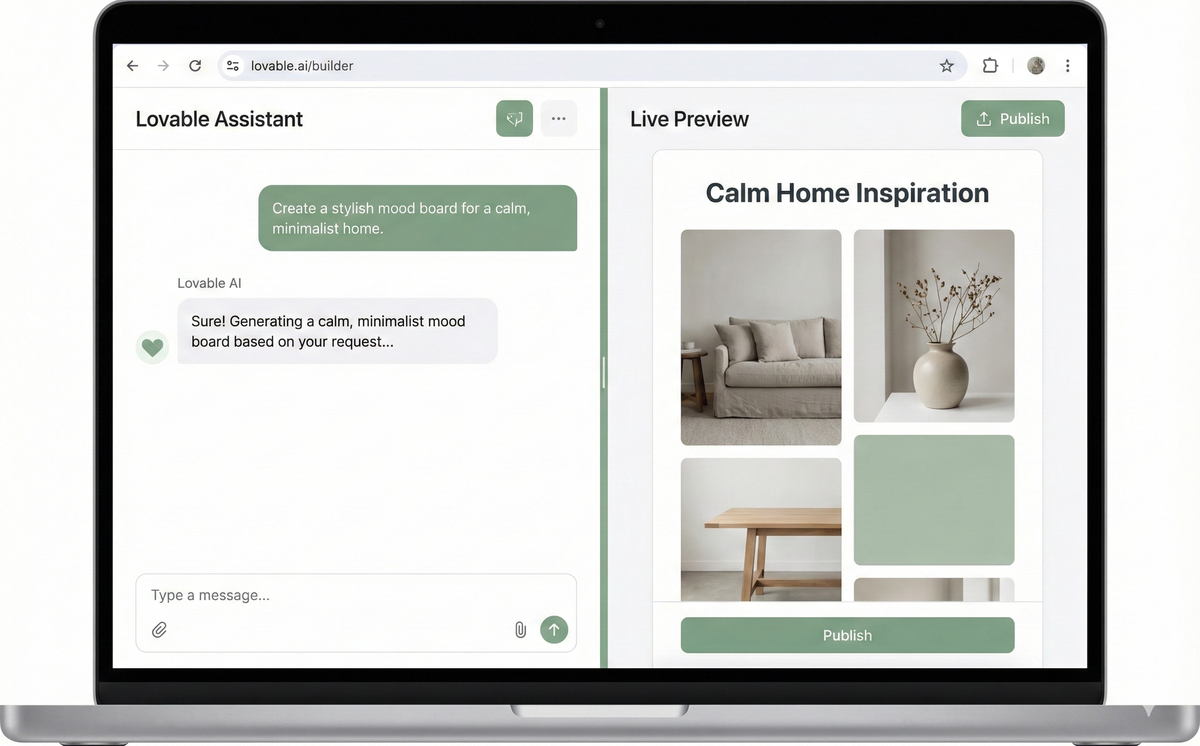
Lovable isn't just another chatbot that spits out code snippets you have to copy-paste. It’s a full-stack builder.
When you describe an app to Lovable, it doesn't just write the code; it builds the real thing in front of your eyes. It handles the database, the user authentication, the design, and the deployment.
It feels less like "programming" and more like "directing." You sit in the director's chair and tell the AI actor what to do. If the button is too aggressive, you say "chill that button out." If the layout feels cluttered, you say "give this some air."
Let's Build: The "Mood Board" App
To show you how this works, let's build a simple app: a personal Mood Board where you can save images and colors that inspire you.
Step 1: The Prompt (Setting the Vibe)
We start with a plain English description (think of it as a mini-spec sheet). No technical jargon allowed.
Prompt: "I want a personal mood board app. It should feel like a high-end fashion magazine. Minimalist, lots of white space, elegant serif fonts. I need a grid where I can upload images and add a short caption. Let me toggle between 'Light' and 'Dark' modes, but keep the dark mode feeling like a charcoal sketch, not pitch black."
Step 2: The Iteration (Refining the Vibe)
Lovable generates the first version in about 60 seconds. It’s good, but not perfect. The font is a bit too small.
Vibe Check: "The captions are too tiny. Bump them up and make them italic. Also, the 'Upload' button looks too corporate. Make it round and soft."
Lovable updates the app instantly. You don't look at a single line of CSS. You just critique the vibe.
Step 3: Deployment
Usually, "deploying" an app involves servers, DNS records, and headaches. With Lovable, you click "Publish."
That’s it. You get a URL you can send to your friends. You have built a functional, database-backed web app without writing a single line of code.
The Reality Check (It's Not All Magic)
Before you fire your engineering team, let's look at the limitations. As of February 2026, vibecoding has a few speed bumps:
- The "90% Trap": Lovable is incredible at getting you 90% of the way there. But that last 10%—complex custom logic, specific payment integrations, or obscure bugs—can still require a human who knows how to read code.
- It Costs Money: Real computing power isn't free. While there's a starter tier, building a production app will cost you around $20–$50/month for a Pro plan. The "free lunch" era of AI is over; you are paying for the "intelligence" of the model.
- Maintenance: An app is like a garden; it needs weeding. If an API changes next year, your AI-built app might break, and you'll need to ask the AI to fix it (or hire someone who can).
Wait, Is the Code Garbage?
Actually, no. Historically, "no-code" tools produced messy, unreadable spaghetti code that real developers hated. Lovable is different. It spits out clean, standard React and TypeScript—the exact same languages professional developers use at companies like Airbnb and Netflix. You aren't locked in. You can click "Export," hand the code to a human developer, and they can pick up right where the AI left off. This is a massive safety net.
A Note on Security (The "Junior Dev" Rule)
While the code is clean, treat it like it was written by a talented junior developer. AI is great at syntax but sometimes naive about security. It might forget to rate-limit a login page or accidentally expose a database row it shouldn't. The Golden Rule: Use vibecoding for internal tools, prototypes, and MVPs freely. But before you handle real customer credit cards or medical data, get a human expert to audit the code.
But Here's the Catch...
These tools are improving weekly. In 2024, AI struggled to write a Snake game. In 2025, it could build a blog. Now, it's building SaaS platforms. The gap between "what you can describe" and "what it can build" is closing faster than any technology we've ever seen.
The "So What?"
Why does this matter?
For the Non-Coder: The barrier to entry has collapsed. If you can describe it, you can build it. That business idea, that internal tool for your team, that digital birthday card—you can just make it.
For the Pro-Coder: This is a speedrun. You can use vibecoding to prototype the boring stuff (login screens, settings pages) in minutes, saving your brainpower for the complex, unique logic that actually requires human engineering.
We are moving from a world of Software Engineers to a world of Software Directors. The skills you need are changing. It’s less about memorizing syntax and more about cultivating taste, clarity, and vision.
So, what's your vibe?
Ready to try it? Check out Lovable.dev and start building.
Want to keep learning?
Get our free AI Starter Kit — 5 lessons delivered to your inbox.
Join readers learning AI in plain English. No spam, ever.